

“I never read, I just look at pictures”
—Andy Warhol
There’s a coaster hanging on the wall in my studio. I got it in a bar somewhere—I don’t remember where. It says: “Tell me your dreams.”
The other morning, I was on the bus on my way to work, seated facing the side window, looking toward the street rather than the front of the bus. Somewhere along my route, I noticed a large nutrition label in the window of a physical therapy practice.
I had seen the place before. I assumed the nutrition label described what they offered, although the bus didn’t stay there long enough for me to read it.
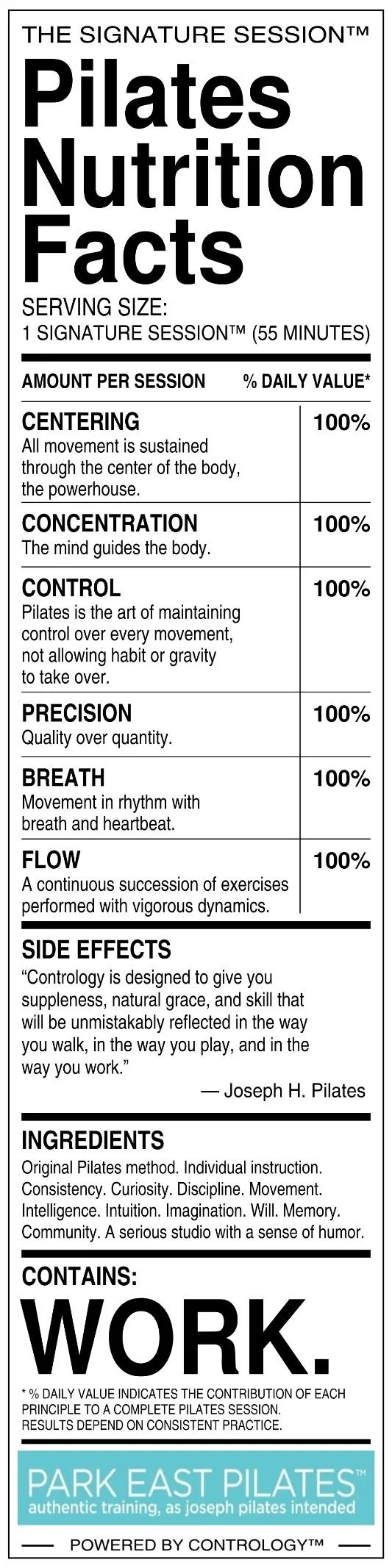
My immediate thought was: that would be great for Pilates.
When I got to the studio, I looked in the refrigerator for something with a nutrition label. There was a bottle of Trader Joe’s kefir. I photographed the nutrition label and started thinking: what would the ingredients of a Pilates session be?
Of course, the six principles.
Centering. Concentration. Control. Precision. Breath. Flow.
It didn’t take much deliberation. They were the natural choice.
One hundred percent of each
The goal is to have all six principles present in every exercise, throughout the practice. Whether you’re learning a few beginner exercises or working through the advanced system, that remains the work.
Which is why each principle on the Pilates nutrition label is listed at 100 percent. We’re aiming to bring all of them together, at the same time.
And what do those levels mean, anyway? “Beginner,” “intermediate,” “advanced,” and “super advanced” describe the difficulty of the exercises as we categorize them within the system. How you perform them can reveal the degree of control and skill you’ve developed—and your ability to apply what you’ve learned to increasingly complex movement, in the studio and in everyday life.
That competency can make a meaningful difference in your life. The levels themselves, though, aren’t a measure of your worth as a person.
I’m interested in how someone practices. Can they perform the beginner system with centering, concentration, control, precision, breath, and flow throughout the entire session? That is interesting. That asks a great deal.
Actually, I’m the one asking a great deal of myself. Every beginner exercise gives me the opportunity to keep bringing those principles together.
It takes study and study and practice and practice and study and practice. And more study and more practice.
I find that concentration relaxing. When I’m so absorbed in the work, everything else falls away. That, in itself, is part of why I love it.
A dance with the apparatus
The principles are interconnected. Centering and concentration help you develop control. Precision means learning to do something on purpose, because you’re choosing to do it. Breath is part of the movement throughout. Flow develops within an exercise and between exercises. At first, your teacher adjusts the springs and the headpiece and tells you what comes next. They may even clean the equipment for you after the session.
Eventually, you learn to do these things yourself. Setting up, making adjustments, moving between exercises, and cleaning afterward all become part of your practice. You know what to do, and you continue. You keep the cadence, build stamina, and work with different dynamics.
It becomes a dance with the apparatus, whatever piece of equipment you’re working on.
The teacher participates in this, too. Over the years, I’ve noticed that if I’m not concentrating, the person I’m teaching isn’t concentrating. If I’m locked in, they’re locked in. We create the environment for each other.
Every day in my teaching, I discover something about the body by observing it in someone else. My understanding keeps developing. I love learning, and I’m open to seeing something and letting it work on me.
There isn’t one moment when everything suddenly makes sense. It’s a continuous practice and a continuous discovery.
Learning to listen
Dance gave me something I brought into Pilates: learning how to listen.
In a ballet class, you listen to corrections. You also listen when the teacher corrects somebody else and consider whether that correction applies to you. There is so much to learn from paying attention to what is happening elsewhere in the room.
You learn to receive a correction as a gift the teacher shares with you. To be corrected and coached is a gift—if you’re willing to be coachable.
That listening makes you highly aware of your surroundings and in tune with them, while remaining one hundred percent engaged in your own practice. You’re attentive to what’s around you without becoming distracted from what you’re doing.
I had that experience before I began Pilates. But hearing a correction and understanding how to apply it to your own body can be very different things.
As a younger dancer, I might hear that I needed to work on my turnout or stretch more. But how? I didn’t understand anchoring a joint or creating opposition in the way I do now: maintaining that anchor while reaching in opposing directions—up and down, side to side, forward and back. Sometimes it felt like guesswork.
Practicing and teaching Pilates has changed that. And when I returned to dance at 47, I brought that developing understanding back into class.
The exchange goes both ways. I brought what I had learned from dance into Pilates, and what I continue to learn from Pilates informs my dancing.
What the practice makes possible
Take Stomach Massage on the reformer. It’s not one of my favorite exercises. It’s a lot of work—a pain in the butt to do, in my opinion.
But I love what it has taught me about pulling in and up and sitting upright. I can bring that understanding into Feet Coming Forward in Graham class.
It makes practicing another movement with integrity a possibility.
The Stomach Massage series is also understood as a way of massaging the internal organs, with possible benefits for digestion. That interests me, too: what might be happening internally, beyond what someone watching the exercise can see. Pilates is very internal.
That’s why practicing the original Pilates method is such a great cross practice for me. I have ambitions for my dancing. I want more mobility in my spine and more openness in my hips. With that, fuller movement and greater artistic expression on stage become possible. Recently, I started taking back-bending and splits strength classes because I wanted the kind of training young dancers and gymnasts receive, in the format of an adult class.
What I’ve learned through Pilates helps me approach that work with alignment, attention, and purpose. The teacher has noticed my alignment. I notice it, too.
I can also evaluate a class: what am I learning? If I apply myself and practice what I’m being taught, what benefits and results can I reasonably expect over time? How do I approach what’s being asked of me? I can participate while exercising my own judgment.
The Pilates nutrition label could serve that purpose for someone else. Look at a class, a workout, or, for example, a YouTube video labeled a “Pilates workout.” Are these principles present? How are they being taught? How are they being practiced?
There is a design to it
A few years ago, I tried an experiment: using things as designed.
A vacuum cleaner, a blender—these things come with instructions. Actually, now I remember what it was: the nut milk maker. I was struggling with it and thought: perhaps I’m not using it as intended. Let me find out.
The small IKEA kitchen in my studio is another example. I could have arranged to have it installed, but I wanted to see whether I could build it myself—with a friend’s help, of course. I did the strategy and thinking work. IKEA manuals can be quite complex. You really have to follow the instructions and look at the pictures.
So far, everything is where it’s supposed to be. Nothing has fallen apart. So I guess we did it correctly.
Asking how something was intended to work made my life easier. Even with something like customer service, I became better at understanding a process before insisting it should work my way. I also became clearer about whether I wanted to participate on those terms.
It helped me set boundaries around what I’ll accept and what I won’t accept.
There is a design to the Pilates method, too. To the exercises. To the apparatus. There is something to understand and study in how they work together.
My trust in that began during my apprenticeship with Romana, teaching my “guinea pig” friends. I didn’t yet have the understanding I have today. I followed the guidelines I had learned, and I saw them work.
Across my own practice and more than 26 years of teaching, that trust has continued to grow. In my experience, the method, taught as intended, has never failed me or my clients and students. It’s why I’m so insistent on teaching the original method as I learned it.
I’ve never found a reason to reinvent it. I’m still discovering more within it.
Bringing it to its essence
I love modern design. Editing and bringing something to its pure essence is a physical, mental, and intellectual exercise.
That intrigues me. It makes me so happy. I love that opportunity in everything I do.
In teaching, I watch where someone naturally goes. Where do they position themselves when they believe they’re aligned with the equipment, before I’ve offered a correction? Sometimes no correction is needed. What shortcuts might they employ in their practice to get where they want to be? What effort is unnecessary? What are they doing that gets in the way of the movement?
And I watch how that changes during the session. Someone might lie down on the reformer at the beginning and need help finding their alignment. Later, when they lie down again for another exercise, they find it themselves. I don’t have to correct as much anymore.
That happens so often. Throughout the session, we’ve been working on alignment, and it becomes their new normal—at least for that hour.
I also find that I need fewer words. That’s something I challenge myself to do: speak just enough to offer a correction or a tip where it’s needed. I want to take myself out of the workout, give the person room to practice, and let them concentrate without me talking all the time.
That, too, is part of creating the environment of the session.
I imagine something of that experience in Joseph Pilates’ studio: people coming in to do their own workouts, with his guidance and other people practicing around them. There could be community and, at the same time, that very personal time with your own practice. I can imagine how meditative that could feel.
That’s something I want to provide for my clients and students.
Over time, we edit. We strip away what isn’t needed.
The more advanced somebody becomes, the clearer their work becomes and appears. Some of the changes are tiny. It requires a highly trained eye to see these things in a video someone has recorded of themselves, or when teaching online. Working through the camera adds another layer to my ongoing development as a teacher.
What I miss is being able to make a physical adjustment when I know it would help the person. I can’t reach through the camera—not yet, at least.
For me, there is so much to enjoy in that attention—in continuing to look, understand, and refine.
Tell me your dreams
I hope the Pilates nutrition label makes people curious.
Perhaps they’ll wonder how these principles could help them in their everyday activities. Perhaps they’ll begin to think differently about how their body is organized, or become curious about the principles underlying something else they do.
There is something you can learn and practice in pursuit of what you want to achieve. You don’t have to leave everything to luck or assume that possibility belongs only to people born with the “right body.”
As you learn, practice, and discover what your own body can do, you build confidence in yourself. You begin to recognize possibilities you might not have imagined for yourself before.
For me, that understanding reaches into dancing, learning, making choices, and setting boundaries. It’s part of what Return to Life Through Contrology means in my own life.
And it brings me back to the coaster on the wall.
Tell me your dreams.
What would you like to be able to do? What would you like to learn? What would you like to make room for?
That’s why I teach: to be fully engaged in my own life and with the people in it.